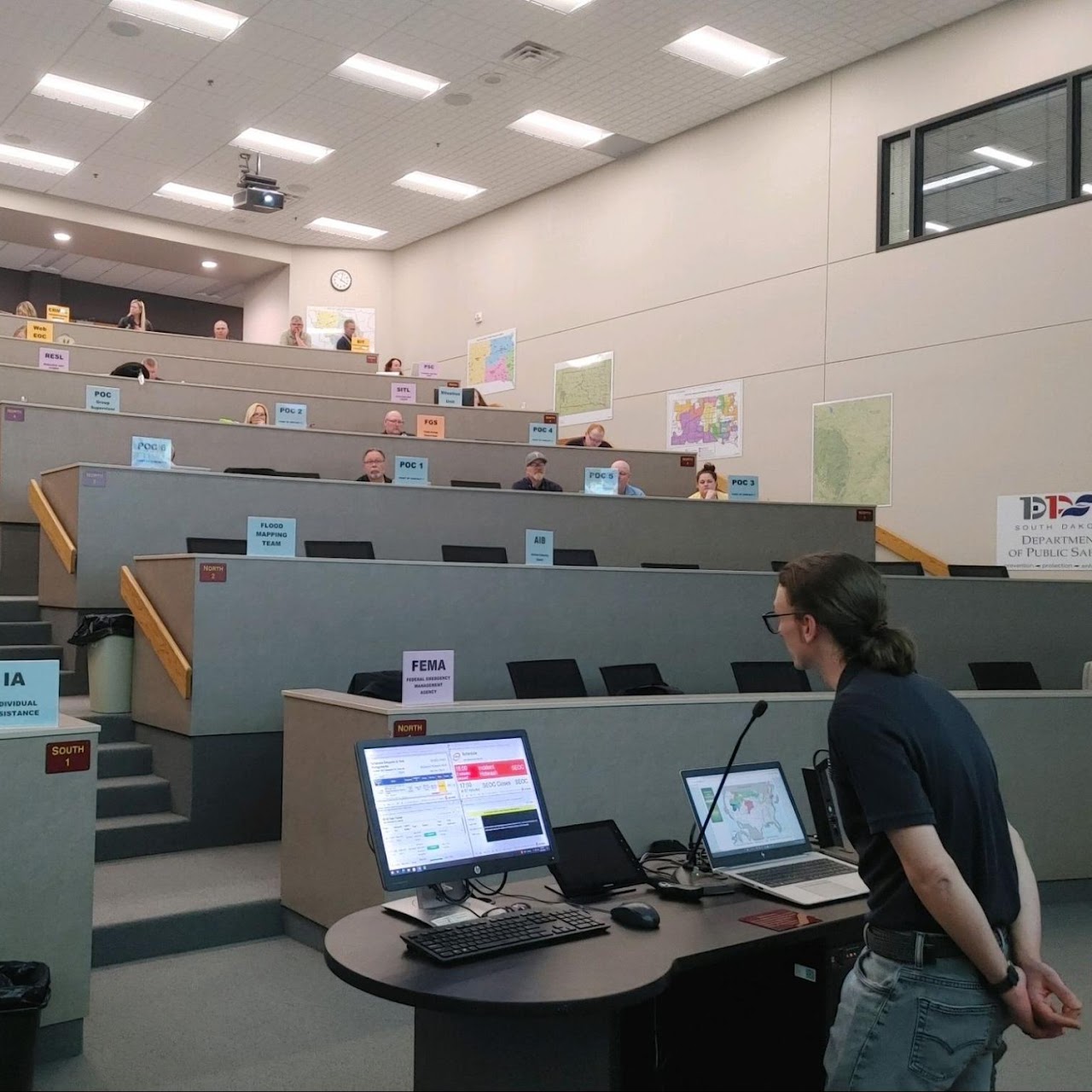
Currently, I serve as the acting lead for the new Mutual Aid Unit within the National Weather Service (NWS)’s Office of Mission Delivery. Introduced in the NWS reorganization, the Mutual Aid Unit plays a critical role in the NWS mission by ensuring core functions and helping to deliver optimal services.
From January 2025 to spring of 2026, I served as the NWS Severe Weather Program Coordinator. In this role, I led strategic planning and national-level coordination of severe weather policies, ensuring alignment across operations, research, and training.
Previously, beginning in September 2017, I was a meteorologist at the NWS Forecast Office in Rapid City, SD. For over seven years, I delivered critical, time-sensitive forecasts during high-impact weather events across western SD and northeastern WY. To accomplish the NWS’s mission of protecting life and property, I collaborated closely with emergency managers, media, and other partners to ensure clear communication of weather-related risks.
Outside of NWS Rapid City, I was a member of NWS Central Region’s Convective Warning Improvement Project (CWIP) team. My primary contributed deliverables for the team were the production of several training modules in the Quasi-Linear Convective System (QLCS) Curriculum, three modules focused on high-shear, low-CAPE (HSLC) severe weather, and QLCS Radar Feature Catalog entries. The team’s work “developing and delivering exceptional training which resulted in an improved tornado warning decision-making process within the NWS” was recognized with a NOAA Administrator’s Award in 2021.
Before joining the NWS full time, I was a Pathways Intern at NWS Raleigh while completing my Ph.D. in Atmospheric Sciences at NC State University. My primary research interest is severe convection, particularly that occurring within HSLC environments common across the southeastern U.S. in the cool season and overnight. The Severe Hazards in Environments with Reduced Buoyancy (SHERB) parameters were developed during my M.S. research.
Professional contributions outside of the workplace include membership on the American Meteorological Society (AMS)’s Severe Local Storms Committee and the National Weather Association (NWA)’s Weather Analysis and Forecasting (WAF) Committee. Additionally, I serve as an Editor for AMS’s Weather and Forecasting.
My Core Values
Character | Well-Being | Respect | Growth | Collaboration
Education
Ph.D., Atmospheric Sciences (2018), NC State University, Raleigh, NC
M.S., Atmospheric Sciences (2013), NC State University, Raleigh, NC
B.S., Meteorology (2011), University of Oklahoma, Norman, OK
Peer-Reviewed Publications
Kuster, C. M., K. D. Sherburn, V. N. Mahale, T. J. Schuur, O. F. McCauley, and J. S. Schaumann, 2024: Radar Signatures Associated with Quasi-Linear Convective System Mesovortices. Wea. Forecasting, 39, 1143–1161.
Borchardt, B. S., K. D. Sherburn, and R. S. Schumacher, 2024: Radar Signatures and Surface Observations of Elevated Convection Associated with Damaging Surface Winds. Wea. Forecasting, 39, 943–963.
Sherburn, K. D., M. J. Bunkers, and A. J. Mose, 2021: Radar-Based Comparison of Thunderstorm Outflow Boundary Speeds versus Peak Wind Gusts from Automated Stations. Wea. Forecasting, 36, 1387–1403.
Sherburn, K. D., and M. D. Parker, 2019: The development of severe vortices within simulated high-shear low-CAPE convection. Mon. Wea. Rev., 147, 2189-2216.
Sherburn, K. D., M. D. Parker, C. E. Davenport, R. A. Sirico, J. L. Blaes, B. Black, S. E. McLamb, M. C. Mugrage, and R. M. Rackliffe, 2019: Partnering research, education, and operations via a cool season severe weather soundings program. Bull. Amer. Meteor. Soc., 100, 307-320.
King, J. R., M. D. Parker, K. D. Sherburn, and G. M. Lackmann, 2017: Rapid evolution of cool season, low CAPE severe thunderstorm environments. Wea. Forecasting, 32, 763-779.
Sherburn, K. D., M. D. Parker, J. R. King, and G. M. Lackmann, 2016: Composite environments of severe and non-severe high-shear, low-CAPE convective events. Wea. Forecasting, 31, 1899-1927.
Sherburn, K. D., and M. D. Parker, 2014: Climatology and ingredients of significant severe convection in high shear, low CAPE environments. Wea. Forecasting, 29, 854-877.
Recent Presentations and Training Materials
“Leveraging Satellite Data for Mesoanalysis during Severe Weather Operations”
Satellite Book Club, May 2025
High-Shear, Low-CAPE (HSLC)
Convective Warning Improvement Project (CWIP) Training, February 2024
Severe Weather Series
“Horizontal Shearing Instability and Its Potential Role in QLCS Mesovortexgenesis”
NWS Central Region Guest Speaker Series/Innovation Spotlight, September 2023
“Elevated Convection: Radar Signature and Possible Mechanism for Damaging Surface Wind Production”
NWS Central Region Guest Speaker Series/Innovation Spotlight, February 2023
with Brett Borchardt, NWS Chicago;
Paul Schlatter, NWS Boulder;
and Dr. Russ Schumacher, Colorado State University